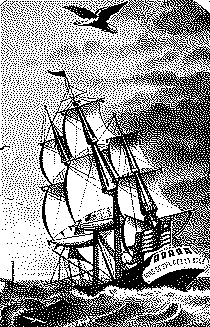
'Be careful when we land - there could be a native behind every tree!'

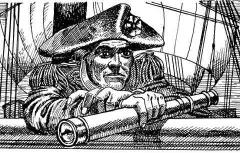
YOU MAY RECALL we left the master of the Deptford, Dudley Digges, in a quandry—should he set a course for Madeira based on his dead reckoning, or should he trust his passenger's clock and set an entirely different course? He knew he had to choose carefully, because he could easily sail right past Madeira if he got it wrong, and not realise it for days. Luckily for him, his commitment to testing the clock made him choose the latter, and they sighted land the next morning.
Digges was by now so impressed with the timepiece that he offered to buy the first one that the Harrisons put up for sale. He probably didn't realise the eventual asking price would be the equivalent of £10,000 (US$14,300) in today's money.
The Deptford arrived at Port Royal, Jamaica on January 19, 1762, after 81 days at sea. In accordance with the Board of Longitude's requirements an astronomer determined local noon, and then he and Harrison compared their watches to fix the longitude of Port Royal by the time difference between them. When compared to the known longitude, and allowing for the watch's predetermined error of two and two-thirds seconds per day, it was found to be 5 seconds slow. In other words, the watch had kept time to 0.06 seconds per day, resulting in an error of 1.25 minutes of longitude, which was more than adequate to claim the first prize. However, the Board of Longitude was not going to give up that easily, and it ordered more sea trials on the pretext that it was just a fluke the watch performed so well. Despite protests from the Harrisons and further tests, it was going to take the intervention of King George III and Parliament, and a further 11 years, before John Harrison received an amount approximating the grand prize—and that was from Parliament, not the Board. As it turned out, the Board never did pay out on the grand longitude prize.
John Harrison died in 1776, three years after receiving the money from Parliament. Two hundred years later Neil Armstrong paid tribute to him, saying that his chronometer enabled Man to explore Earth with precision, and then to build navigational systems for voyages to the moon. Which brings us neatly back to where we started—with the Skyhawk, the longitude watch for the space age. I hope you've enjoyed the journey.